

How Pricing Shapes Brand Perception and Signals Value?
High prices can represent more than quality; they signal position. Your pricing can reflect the type of experience, personality, or values your brand represents.
DEMAND GENERATIONB2B STRATEGY
1/20/20266 min read
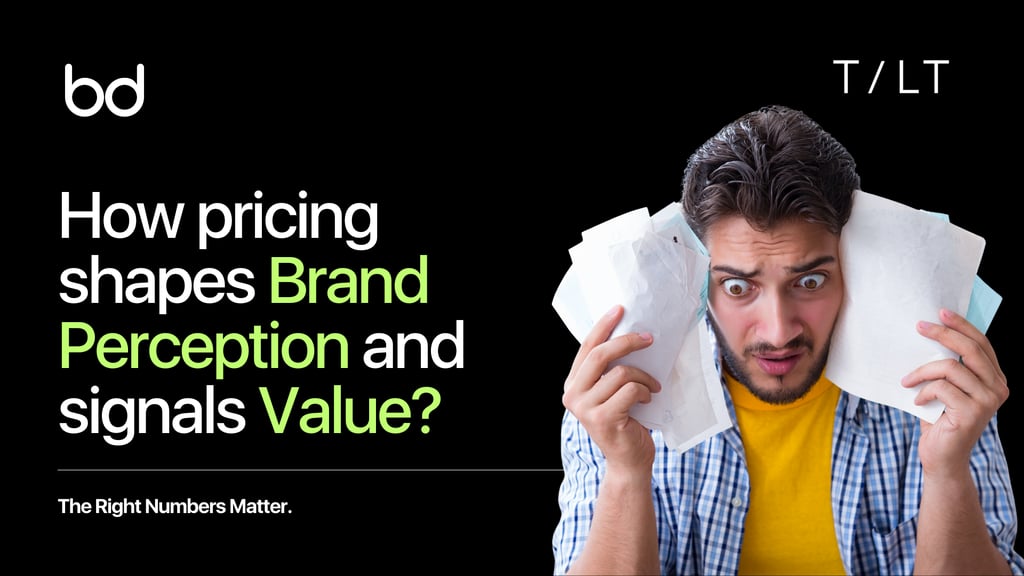
Pricing isn’t just about covering your costs or making a profit; it’s one of the strongest ways to communicate your brand’s value.
The price you set tells people what to expect from your brand. It can shape how they perceive your quality, your positioning, and even how loyal they become.
In this guide, let’s explore how pricing and brand perception work together, how you can use pricing to strengthen your brand’s positioning, and a few psychological techniques to make your pricing more effective.
How Price Signals Added Value
Price as a Sign of Quality and Value
Pricing and perception are closely intertwined. A higher price often tells people, “this brand must be good quality.”
In fact, a 2021 NielsenIQ study found that 86% of consumers connect higher prices with higher quality. But interestingly, a McKinsey study on European consumers shows that people now care just as much about value for money, things like variety, convenience, and overall experience.
This is where the halo effect comes in: when one positive trait (like premium pricing) influences how we view the entire brand. People assume that something expensive must also be better crafted, more reliable, and designed with care.
Premium Pricing: Ritz-Carlton
For example, The Ritz-Carlton uses premium pricing to reinforce exclusivity. Its high prices work because they match a truly high-end experience, from elegant interiors to outstanding service. The price supports the story.
Accessible Pricing: IKEA and Aldi
At the other end of the spectrum, IKEA and Aldi use lower prices strategically. Their pricing tells a story of accessibility and simplicity. It signals that their brands are for everyday people who value efficiency, practicality, and affordability.
When Discounts Backfire
Discounts can drive short-term sales, but too many of them can harm your brand.
A Harvard Business Review study revealed that frequent discounting can reduce brand value by up to 33%. Why? Constant markdowns make a brand feel cheap or desperate. Customers may start waiting for sales and stop believing in the full value of your product.
Luxury brands avoid this trap by rarely, if ever, discounting. Instead, they raise their prices to reinforce exclusivity.
Price as a Reflection of Brand Positioning
High prices can represent more than quality; they signal position. Your pricing can reflect the type of experience, personality, or values your brand represents.
Here are a few ways brands justify higher prices through positioning:
Unique experiences: Think of walking into Lush, you immediately feel the scents, colors, and textures.
Innovation: Dyson charges more because it promises breakthrough technology and performance.
Distinct voice or personality: Oatly uses witty, self-aware messaging to stand out.
Strong values: Patagonia’s prices reflect its deep commitment to sustainability.
Emotional value: Harley-Davidson sells more than bikes—it sells a sense of rebellious freedom.
For more inspiration, see 18 brand positioning examples to inspire your strategy.
Trust and Transparency in Pricing
Clear, fair pricing builds trust.
Today’s consumers are smart, they compare, research, and spot manipulation quickly. Hidden fees or misleading “discounts” can instantly hurt your credibility.
Some brands, like Everlane, are leading with total transparency. They openly show what each product costs to make, including materials, labor, transport, and so on. This honest pricing approach not only supports their ethical positioning but reassures customers that they’re paying fairly.
How Pricing Shapes Brand Equity and Loyalty
A thoughtful pricing strategy doesn’t just drive sales—it strengthens brand equity.
Brand equity is the intangible value people associate with your brand—built from awareness, trust, and perceived value. The stronger your brand equity, the easier it becomes to charge premium prices confidently.
But here’s the catch: consistent discounting or pricing too low can erode that equity. It sends mixed signals about your worth and weakens long-term loyalty.
Understanding Price Elasticity
Price elasticity measures how demand changes when prices go up or down.
Elastic pricing: Demand changes dramatically when prices shift. This is common in competitive, price-sensitive markets, like budget airlines or fast fashion.
Inelastic pricing: Demand stays stable even when prices rise. This is often the case with strong, differentiated brands, like luxury or niche products.
If you want brand power, aim to make your pricing more inelastic by building distinct value and an emotional connection.
Common Pricing Strategies That Shape Perception
Understanding how pricing affects perception is one thing. Using it intentionally is what separates a good brand from a great one.
Here are key strategies brands use to shape their positioning:
1. Premium Pricing
Set your prices higher than the market average to signal quality, craftsmanship, and prestige. Just make sure the entire experience backs it up from packaging to service.
Example: Ferrari
Every car is handcrafted, exclusive, and high-performing. The price itself adds to its allure.
2. Economy Pricing
Keep prices low to reach a wide audience, focusing on practicality and smart design rather than prestige.
Example: IKEA
Affordable prices reinforced by clever, flat-pack design. Affordable doesn’t mean cheap it means efficient and thoughtful.
3. Masstige Pricing (“Prestige for the Masses”)
Combine luxury appeal with accessible pricing to attract both premium and mainstream audiences.
Example: BMW 1 Series
An entry point into a premium world still aspirational but more attainable.
4. Competitive Pricing
Set prices similar to or slightly below competitors. Win trust by offering more service, value, or convenience.
Example: Casper
Delivers quality mattresses directly to customers, cutting out retail middlemen for better value.
5. Parity Pricing
Match competitor pricing, but emphasize unique advantages like innovation, service, or emotional value.
Example: Samsung
Prices its phones similarly to Apple but differentiates through high megapixel cameras and varied product features.
6. Value-Based Pricing
Price based on the perceived value, not production cost. Understand how much your audience believes your solution is worth.
Example: Pharmaceutical Industry
Drugs that treat rare diseases are priced based on their life-saving potential, not manufacturing cost.
7. Dynamic Pricing
Adjust prices in real-time based on demand, competition, or timing.
Example: Uber
Surge pricing rates increase during peak hours or bad weather.
8. Freemium Pricing
Offer a free basic version, and charge for advanced features. It’s a smart way to attract a large user base.
Example: Spotify
Free streaming with ads, or upgrade to Premium for ad-free listening and offline access.
9. Tiered Pricing
Offer multiple packages (“good, better, best”) to cater to different customer segments.
Example: Mailchimp
Different pricing tiers depending on company size and feature needs.
10. Subscription Pricing
Charge customers a recurring fee for ongoing access creating predictable revenue and stronger retention.
Examples: Netflix, Adobe, Dropbox. Each uses subscriptions to deliver continuous value and build loyalty.
11. Pay-What-You-Want Pricing
Let customers decide what they’re willing to pay. When done right, this builds trust and goodwill.
Examples:
Atipo Foundry offers fonts this way, and Radiohead famously released their album In Rainbows with the same model.
12. Skimming vs. Penetration Pricing
Skimming: Start high, then lower the price over time. Ideal for positioning as innovative or premium.
Example: Apple launches new iPhones at high prices, then gradually reduces them.
Penetration: Start low to gain market share, then raise prices after establishing a customer base.
Example: A new local salon offering discounted cuts to attract early clients.
Psychological Pricing Tactics That Influence Decision-Making
Beyond strategy, pricing psychology taps into the way people think and feel about value. Here are a few powerful techniques:
Scarcity
When availability feels limited, urgency kicks in.
Example: “Only 3 left in stock” or “Offer ends soon.”
Used ethically (like limited editions), it creates excitement. Overuse, however, can feel manipulative.
Loss Aversion
People hate losing something more than they love gaining.
Example: A freelancer might frame branding as, “If you don’t invest in your brand, you’ll lose leads and revenue.”
It shifts focus from what they gain to what they risk losing.
Anchoring
Start with a high-priced option so other prices seem more reasonable.
Example: A $500 suite makes the $250 room look like a great value.
Charm Pricing
Prices ending in .99 or .95 feel more affordable—$9.95 feels cheaper than $10.
But for high-end products, rounded numbers (like $500) feel more luxurious and trustworthy.
The Decoy Effect
Add a third “decoy” option to nudge customers toward the price you want them to choose.
Example: A café listing coffee sizes at $3 (small), $4.50 (medium), and $7 (large) makes the medium feel like the best value.
Bundling
Offer several products together at a slightly lower combined price.
Example: Amazon book bundles buy three for $30 instead of $15 each, encourage larger purchases.
Align Your Pricing with Your Brand Strategy
Pricing is one of the most powerful expressions of your brand. It tells your audience who you are, what you stand for, and what kind of value they can expect.
When done intentionally, pricing can:
Strengthen your positioning
Reinforce brand equity
Build trust and loyalty
Avoid chasing the lowest price; it’s rarely sustainable. Competing on price alone attracts bargain hunters who switch brands the moment a cheaper option appears.
Instead, focus on clarity, transparency, and alignment. Make sure your pricing matches your values, your market, and your audience’s expectations.
Take a moment to ask yourself:
Does your pricing reflect the kind of brand you want to build?
If you’d like to refine your brand strategy or pricing approach, feel free to reach out here.
© 2026 BRNDxMORPH Media WWD Private Limited. All rights reserved.


Brand Blinks Global® | BBG is an independent global brand consulting and transformation company.
The trademarks, logos, and service marks displayed on this site are the property of their respective owners.
"Brand Blinks Global® | BBG," "Brand Blinks®," "Made for the Uncommon®," and the "bd®" logo are trademarks or registered trademarks of BRNDXMORPH Media WWD Private Limited.


RESOURCES
INTELLIGENCE
BUSINESS
PARTNER
